
Do you need a forward-deployed engineer?
How a new role from the AI labs is about to change how brands think about talent
Hello, and welcome to Offcuts: a weekly newsletter about AI and commerce. Written for the people running consumer brands. Brought to you by the team at ROIROI - connecting engineering, design, paid media and AI.
This week two of the biggest AI labs made give moves into the services space. OpenAI finalised The Deployment Company, a $10 billion joint venture with nineteen private equity investors including TPG, Bain Capital and Brookfield. The structure is unusual: OpenAI is guaranteeing its PE backers a 17.5 per cent annual return over five years, in exchange for their portfolio companies becoming a captive customer base for embedded AI deployment. Anthropic announced a similar vehicle the same week, anchored by Goldman Sachs and Blackstone. It would appear that both deals say something similar: the AI labs have concluded that selling models is not the business. Deploying them inside companies is.
That is what this week’s edition is about.
*Offcuts Live - a breakfast with Tim Richardson, Erik Arnewing & Ola Ekerhov
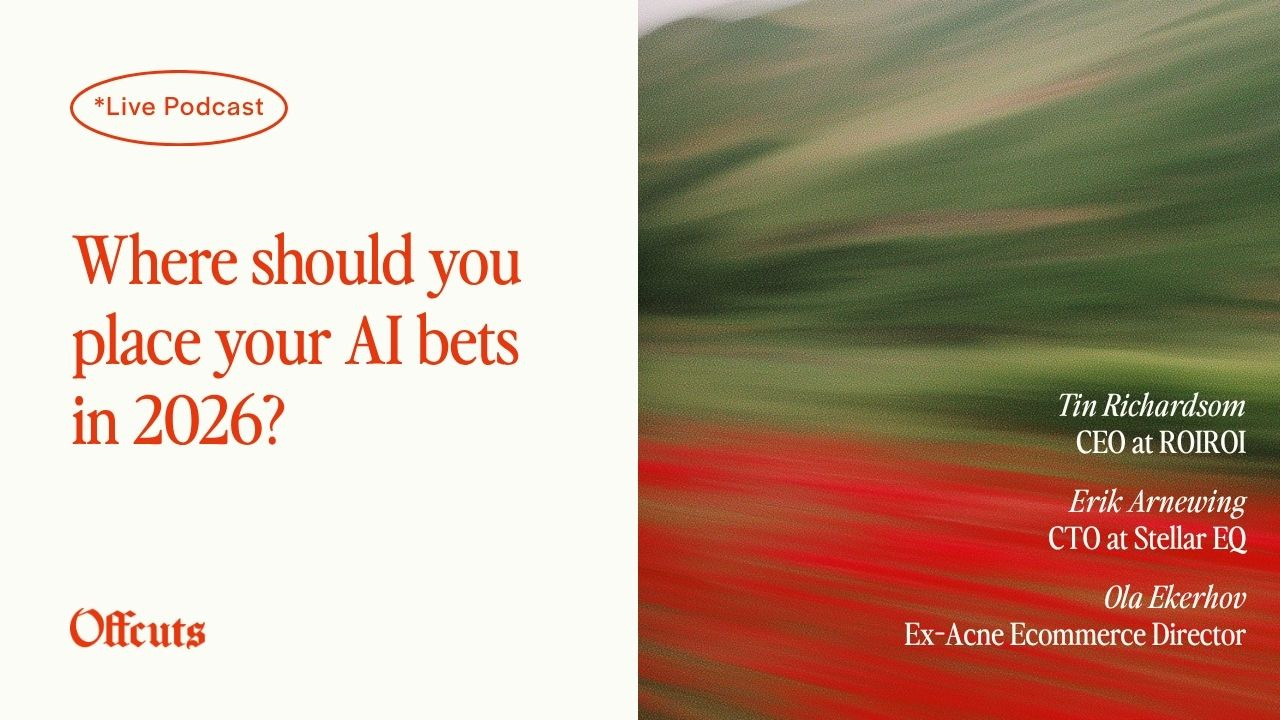
An in-person breakfast and live podcast recording at Centra’s Stockholm HQ, hosted by Centra, ROIROI and DEMA.
One focused conversation about how AI is reshaping commerce: how customers find and buy, and what it takes to embed AI into work that moves the needle. With Tim Richardson (CEO at ROIROI), Erik Arnewing (Stellar EQ) and Ola Ekerhov (Lola Digital Solutions).
Small group. Good coffee. No slides. No pitch.
The role the AI labs invented
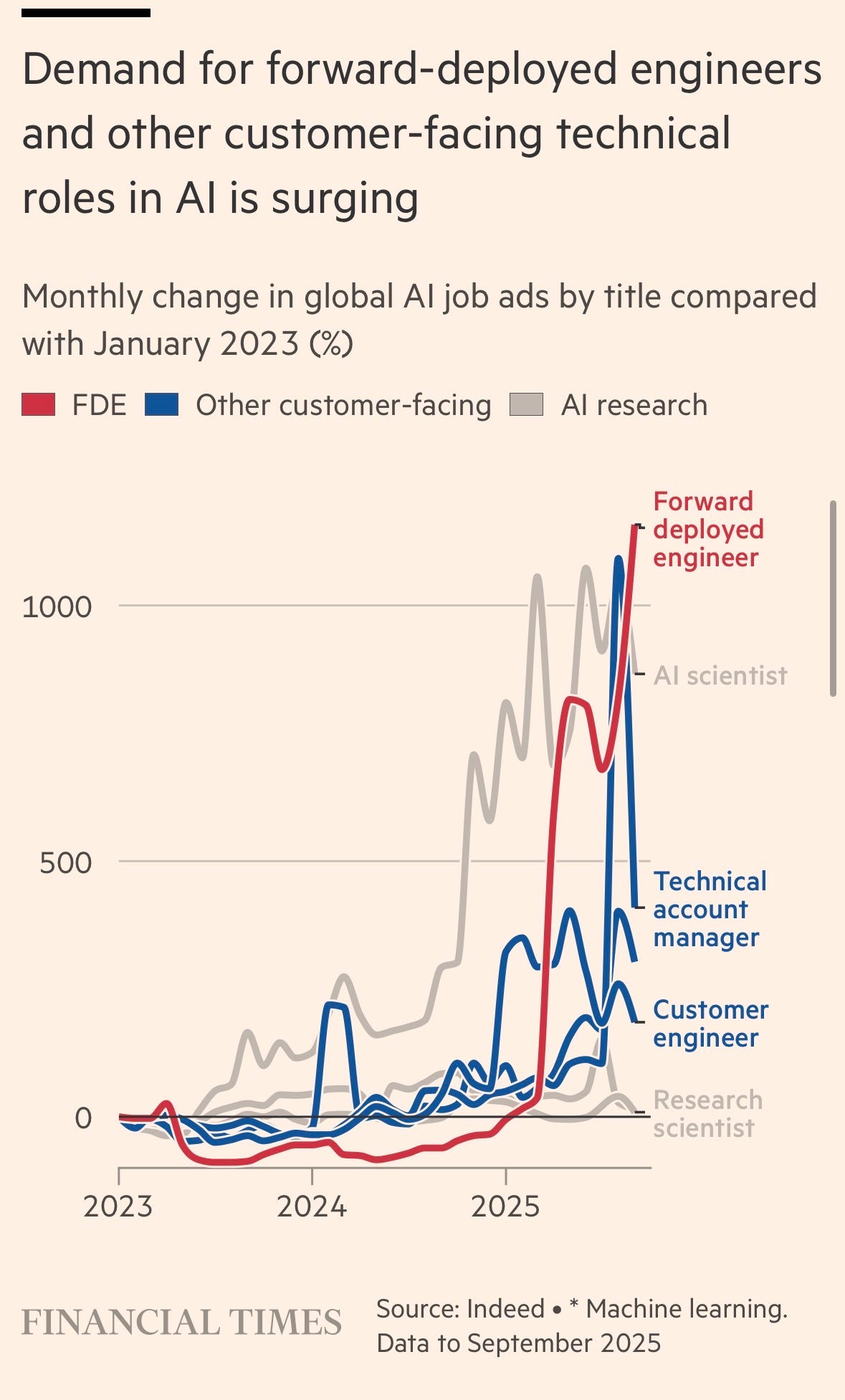
The Financial Times ran a piece recently on a quiet hiring spree inside the same labs. Anthropic, OpenAI and Cohere are all recruiting hard for a role called a forward-deployed engineer. These are not researchers or product builders. They are engineers who embed directly inside customer businesses to help them adopt and customise AI. OpenAI set up an FDE team at the start of this year and expects to grow it to around 50 engineers in Europe alone. Anthropic is growing its equivalent team fivefold. Monthly job listings for this type of role increased more than 800 per cent between January and September last year.
Palantir pioneered the model almost twenty years ago. FDEs now represent about half their workforce. They send customers two people: one charged with understanding what the business actually needs, one with the technical skills to build it. Neither works without the other, as you cannot build the right thing without first understanding the real problem, and understanding the real problem is worthless if nothing gets built.
Side note on Palantir. It is worth being clear that they are a genuinely controversial company, with a track record in defence and government surveillance that sits uncomfortably with many people. Thus, I am not holding it (or especially its founder) up as a model to emulate. Rather, the FDE structure is a useful operational analogy for how embedded AI deployment works, nothing more. The principle - pair the diagnosis with the build - translates cleanly to a commerce context without any of the baggage.
The DeployCo deal is the same logic taken to its commercial conclusion. OpenAI is not just hiring FDEs. It is building a $10 billion vehicle to systematically embed its people and tools inside the operating layer of some of the world’s largest businesses. The labs are not doing this because it is interesting. They are doing it because they have learned, at scale, that handing a business a model and expecting adoption is not how this works. The gap between having AI and using AI is a people problem. It always has been. Further, I think the same principles apply regardless of an organisation's size.
Sponsor
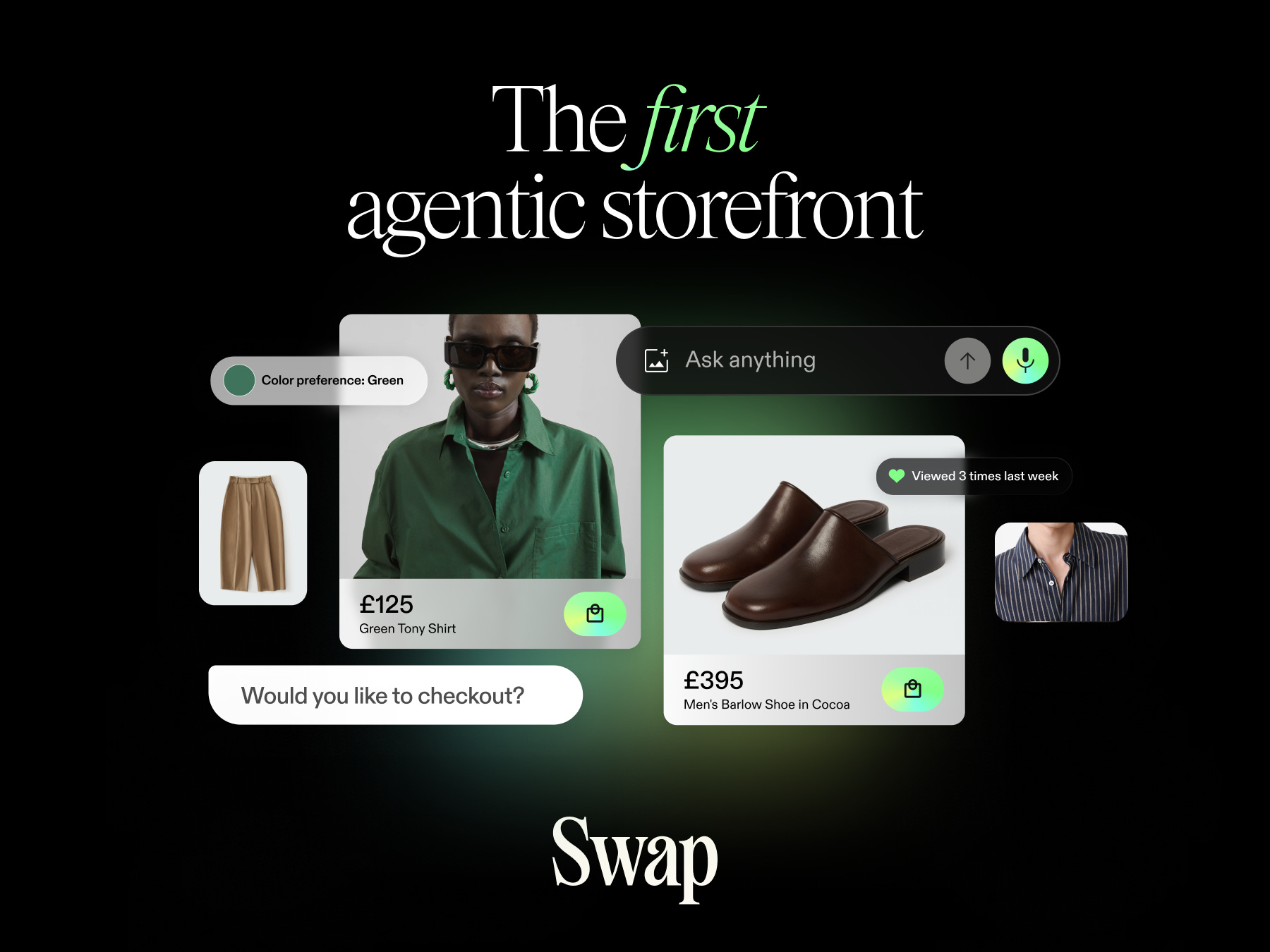
This newsletter is brought to you by Swap - the Agentic Storefront platform replacing traditional ecommerce websites with immersive, AI-led shopping experiences.
If you’re running an ecommerce brand right now, your website is doing you a disservice. It’s static. It just sits there. But your customers want to be guided.
Swap replaces your website with an agent-led experience - taking shoppers from discovery to checkout in a single seamless flow. It learns your catalogue, remembers your customers, and gets smarter every visit. Customers spend twice as long on Swap Storefronts and that time converts.
Book a free demo of Swap here.
Want to sponsor Offcuts? Click here.
What an FDE actually does
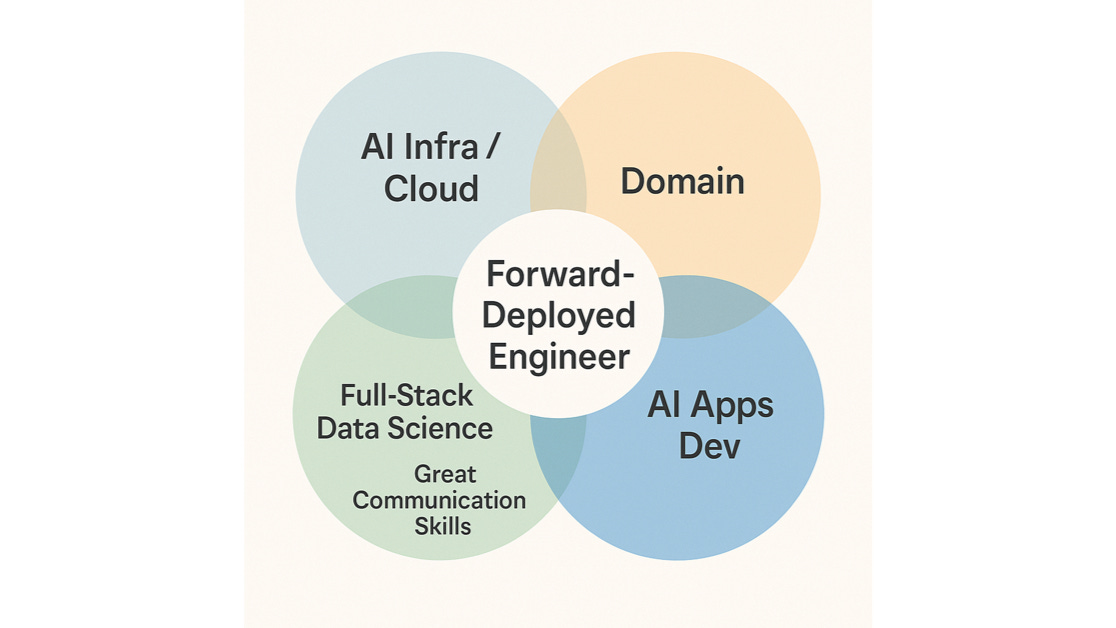
The role sits at the intersection of three things most organisations keep separate: business analysis, software engineering, and change management.
On any given engagement, an FDE might spend the first week doing nothing technical at all. Talking to the operations team about where the manual work actually lives. Sitting with the trading team to understand how decisions really get made, not how the org chart says they do. Mapping which data lives where, who owns it, and what format it is in. This is the diagnostic work. It sounds like consulting (which I know we’re all allergic to). It is not, because the person doing it has enough engineering depth to know which problems are actually solvable and at what cost.
Take a B2B team we were working with recently in Sweden. One person was spending every Wednesday processing orders manually, going through each account, checking what sold, building the replenishment order. A pure consultant would have written a recommendation. A pure developer would have built an automation without asking why the resistance existed in the first place. The FDE approach meant asking both questions simultaneously: why has this not been solved already, and what would it take to build something the team would actually use. The automation eventually saved an entire working day every week.
The second phase is where the build comes in. Something specific: a single agent that handles one workflow, a connection between two platforms that have never spoken to each other, a report that was being produced manually every week. The scope is deliberately narrow. The point is not to build everything at once. It is to build one thing properly, prove it works, and shift the internal conversation from “maybe this could work” to “what do we do next.”
The third phase is the one most AI deployments never reach: making it last. Asking whether the automation still functions when the underlying model changes. Checking whether the architecture holds when a new data source gets added. Making sure the logic is documented before the person who built it moves on. This is where the execution gap lives in practice. Most businesses that adopt AI well have someone doing this work continuously, not just at the point of build. Most businesses that struggle do not.
What brands are hiring instead
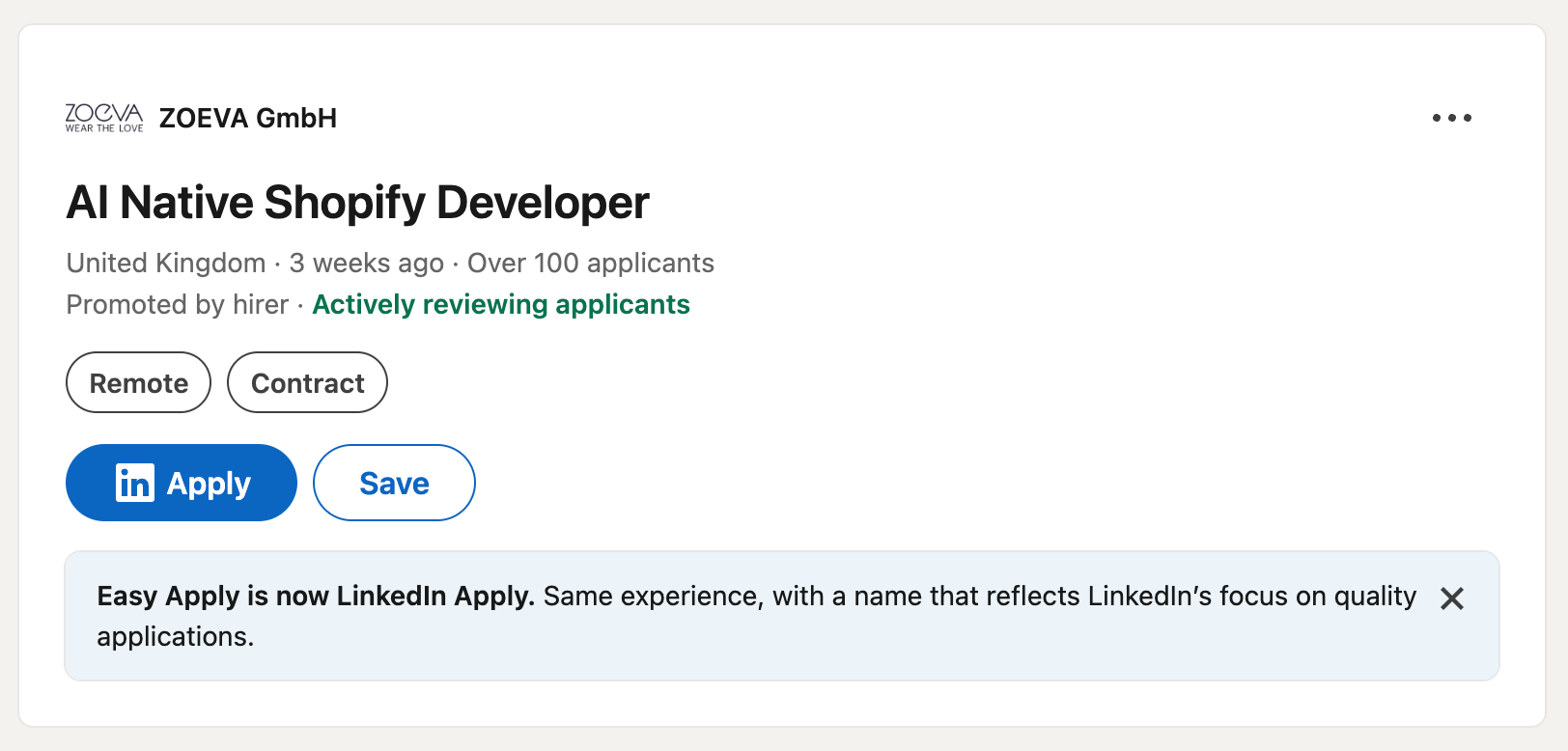
The brand-side response to the AI adoption problem has largely been to hire developers with AI skills. Some of those hires make sense. However, many are solving the wrong problem.
ZOEVA, a prestige beauty brand, recently advertised for what they called an AI-native Shopify developer (shout out to Jordan Philip for making me aware of this role). The role asks for someone who uses Claude Code and Codex as daily tools to build faster. That is a reasonable thing to want. It is not an FDE. Development speed is not the capability gap most consumer brands have. The gap is judgement: someone who understands a commercial problem well enough to know whether AI should solve it, who can design a solution that does not become unmaintainable in six months, and who knows the difference between a proof of concept and something that will survive production. A developer who codes faster is still a developer. An FDE is something closer to a business analyst, a solution architect, and an engineer in the same person, which is a much harder profile to hire for than a job ad suggests.
So should you hire an FDE?
There is a useful historical parallel here. Glossier spent years building proprietary technology in-house, convinced that owning the stack was a competitive advantage. They eventually unwound most of it and moved to Shopify. The lesson was not that technology does not matter. It was that building and maintaining it internally pulled resource and attention away from what actually made Glossier a great brand. The same question is now playing out with AI. However, it’s a little more nuanced.
Hiring an internal FDE sounds like the right answer. But ask it honestly: where do you find someone who can genuinely bridge commercial judgement and engineering rigour, with enough commerce knowledge to be useful in both directions? How do you manage them if your leadership team has not yet built the muscle to direct that kind of work? And what happens when the model they have built everything on gets superseded by a better one next quarter, as it will? A single internal hire cannot keep pace with a landscape that is shifting every few months. They become your single point of failure at precisely the moment when flexibility matters most.
I should be transparent: I run an agency that offers exactly the outsourced model, and I am a recovering AI maximalist. So take the following with appropriate salt. But the framework is worth considering regardless of who delivers it. Does your business need a permanent AI hire, or does it need access to a team (or solo individual - eg a specialist eCommerce AI freelancer) that lives in this space full time, brings pattern recognition across multiple commerce businesses, and stays current because that is the entire job rather than a side responsibility alongside a full delivery role?
A final thought
The billion-dollar vehicles OpenAI and Anthropic announced this week were not built for most of the brands reading this. But the problem they were built to solve is not reserved for PE-backed portfolios or Fortune 500 balance sheets.
This is worth pondering for a moment. Two of the most valuable companies in the world have looked at the AI adoption problem and concluded that the answer is not a better model, a cheaper API, or a more intuitive interface. It is people, embedded inside businesses, asking the right questions before anything gets built. That is a significant admission from organisations whose entire commercial model depends on selling software.
So what does that tell us about where most brands actually are? If the gap between having AI and using it were a technology problem, the labs would be solving it with technology. They are not. They are solving it with services. With the kind of contextual understanding that cannot be packaged into a product and shipped.
Thus, a thought to mull over is not whether your brand needs a forward-deployed engineer. It is whether the people currently making decisions about AI in your business have enough of that contextual understanding to ask the right questions in the first place. Do they know which problems are worth solving? Do they know what good architecture looks like before something gets built on top of bad foundations? Do they know the difference between a proof of concept and a programme? And even if they do (many brands have excellent internal AI folks), do they have the time to systematically move the organisation from AI curious to AI native?
Those are not technology questions. They’re the basic but very important stuff. People, process and culture.
If you want to understand your AI adoption, our AI Readiness Assessment is built for exactly this. One structured day, a clear picture of where you are, and a prioritised view of what to do first. Book an intro call here
About Me

Hi, I’m Tim. I’m the CEO of ROIROI, a technology and marketing agency. We connect engineering, design, paid media and AI for consumer brands. I also host Offcuts, a weekly podcast and newsletter exploring the same themes. Outside of work, I’m usually cycling, swimming, running or in a sauna-cold-plunge trying to recover from all three.