
Can You Make Your Data Query-able?
The infrastructure gap most brands are ignoring

Hello, and welcome to Offcuts: a weekly newsletter about AI and commerce. Written for the people running consumer brands. Brought to you by the team at ROIROI - engineering, design, paid media and AI for consumer brands.
Y Combinator published something recently that I’ve been mulling over more than normal. The best AI-native companies, they argued, have made their entire company queryable. Every meeting recorded, every ticket tracked, every customer interaction captured, all legible to an AI layer that learns from it. This turns a company from an open loop into a closed loop. In an open loop, you make a decision and check the results weeks later. In a closed loop, the system monitors what is happening against what should be happening and adjusts. That is the destination. The question for most brands reading this is whether it is a destination they can reach.
I spoke about this at length with our engineering team. This is what I learned.
The problem with the YC framing

Let’s start with a caveat. Y Combinator is talking about software companies. A tech startup has one codebase, one issue tracker, one Slack, a CRM they chose and configured themselves. Everything they produce is theirs. Making that queryable is hard work, but it is a bounded problem. The data exists in systems they own, built by engineers who work for them, structured in formats they control.
A consumer brand is a different situation. Their operational data does not live in one place they built. It lives in a platform they pay a monthly fee to use, an ERP they have been on since 1997, a marketing suite that exports CSVs on a schedule, an ad platform that gates its data behind its own reporting layer, a 3PL whose API gives read access to some fields and not others. Some of that data they can pull programmatically. Some they receive as a weekly file. Some they cannot access at all without renegotiating a commercial arrangement with a vendor whose interests are not aligned with theirs.
The challenge for a retail or ecommerce brand is not just the brutal integration work YC describes. It is that the data is not fully theirs to integrate. They are tenants in other people’s systems, working with whatever those systems choose to expose.
Sponsor
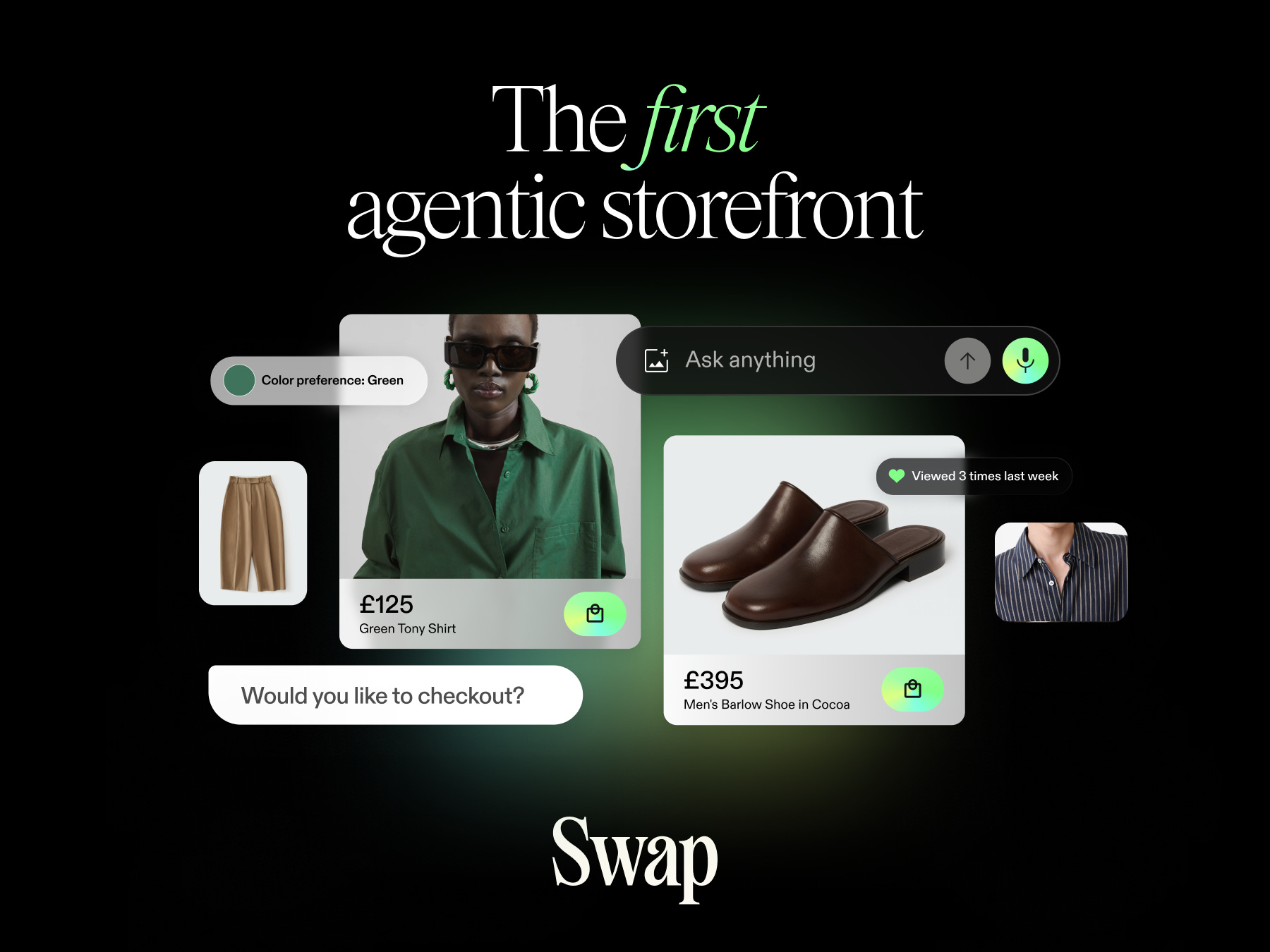
This newsletter is brought to you by Swap - the Agentic Storefront platform replacing traditional ecommerce websites with immersive, AI-led shopping experiences.
If you’re running an ecommerce brand right now, your website is doing you a disservice. It’s static. It just sits there. But your customers want to be guided.
Swap replaces your website with an agent-led experience - taking shoppers from discovery to checkout in a single seamless flow. It learns your catalogue, remembers your customers, and gets smarter every visit. Customers spend twice as long on Swap Storefronts and that time converts. Book a free demo of Swap here.
Want to sponsor Offcuts? Click here.
The two problems underneath the one problem
I put this question to my engineering team last week and the framing that came back was useful. Adam, our Head of Client Strategy, broke it eloquently into two separate challenges: Information and Action.
Information is the foundation. Getting data into a single, structured, queryable place. The principle is straightforward: route everything to a central store, keep it clean, feed your reporting and reasoning tools from there. A lot of brands have parts of this already. Data lakes, BI tools, integration layers that connect their platforms. The gap is usually not the absence of data but the absence of structure. An unstructured database of data from six different systems is not queryable. It is a larger mess in a single location.
Action is harder. An integration layer that connects your systems and moves data between them does not let an AI agent do things on your behalf. That requires your tools to expose what they can do in a way an AI can call on directly. The interesting question is whether the integration work a brand has already done can be extended to cover this, or whether it requires rebuilding from a different starting point. Most brands have not got close enough to answer it yet.
What has to exist before any of this works
Michal, our CTO and one of our resident AI-realists, put it bluntly. An AI-native company is not one that bought an AI tool. It is one that first understood its own data and processes and then gave AI the context to act on them.
That changes the order of operations. Most start with the AI and then try to work out what to feed it. However, the smart ones start with the data mapping and work forward from there. Three things need to be in place before any of it functions.
The data needs to be mapped to the processes it supports, not just stored somewhere.
Calculations need to happen in deterministic logic outside the AI layer, with the model calling the right tool rather than doing the arithmetic itself.
And the agent needs business context: how the company works, what the rules are, how the systems connect.
That last one is where most brands have the biggest gap. The knowledge of how the business works exists in people’s heads, in old Slack threads, in undocumented spreadsheets that one person maintains. An AI agent dropped into that environment does not fail visibly. It produces outputs that are technically coherent and commercially useless.
Why retail is structurally harder
The YC framing assumes the company’s knowledge lives inside systems it controls. For a software company that is mostly true. For a fashion brand, a homeware brand, or a consumer electronics company, a significant portion of the operational knowledge they need to act on lives inside platforms they do not own.
Their product catalogue is in a commerce platform that exposes some attributes via API and not others. Their customer data is split across their ecommerce platform, their ESP, and their loyalty tool, each with its own data model and its own rules about what can be exported and when. Their financial data sits in an accounting system that was not designed to talk to anything else. Their performance marketing data lives inside walled gardens that have a commercial incentive to keep it there.
This is the double problem. The integration work is hard in the way YC describes. But before the integration work is even possible, there is a prior question: understanding what data you can actually get, from which systems, in which format, on what schedule, and at what cost. A lot of AI programmes stall at this point, not because the architecture is wrong but because the brand assumed they had access to data they do not.
Where consumer brands can actually start
Piotr, one of our incredibly senior Software Architects, described something we have been working through with a client: a connective layer built specifically for commerce brands that gathers data from the tools they use, imposes structure and correlation across it, and makes it queryable in a consistent way. Not another dashboard. The infrastructure underneath the dashboard. Channable built a version of this for product feed data, a narrow problem, and it became a substantial business precisely because it solved that one thing properly. The broader version, consistent, structured, queryable data across the full commercial operation of a consumer brand, is still largely unsolved.
The practical starting point is narrower than most brands expect. Pick one operational question you cannot currently answer without pulling data from more than one system manually. Map where that data lives, what format it comes in, and what you can actually access. Build the connection for that one question. Get it working reliably. That single working connection is worth more than a sprawling data strategy document, because it teaches you something real about your stack that no amount of planning reveals in advance.
The brands that get to a queryable data layer will not be the ones that tried to build it all at once. They will be the ones who solved one thing properly, learned from it, and built the next thing on top of something that already worked. Or, they might just wait until Claude just does it all for them.
If you want to map where your business actually sits on this, our AI Readiness Assessment is built for exactly that conversation. One structured day, a clear picture of what you have, what you are missing, and what to build first.
Skin Rocks Case Study
“We brought ROIROI in to run an AI consulting project across the business. In a week they had spoken to every team, mapped our friction points, and produced a roadmap with real commercial impact. They did not try to sell us technology for the sake of it. They told us what we needed to hear, identified a significant saving, and gave us a foundation to build from.”
Gemma Stevenson, Chief Commercial Officer, Skin Rocks
If you want to understand your AI adoption, our AI Readiness Assessment is built for exactly this. One structured day, a clear picture of where you are, and a prioritised view of what to do first. Book an intro call here.
About Me

Hi, I’m Tim. I’m the CEO of ROIROI, a technology and marketing agency. We connect engineering, design, paid media and AI for consumer brands. I also host Offcuts, a weekly podcast and newsletter exploring the same themes. Outside of work, I’m usually cycling, swimming, running or in a sauna-cold-plunge trying to recover from all three.